The following description is taken from a chapter named 'Docks and Steamships' within Charles Herbert Grinling's book published in 1906 and named 'The Ways of Our Railways'. [479]
Under the head of exports the most important commodity dealt with at railway docks is coal. As already stated, the Taff Vale, Barry, Cardiff, and Rhymney railways of South Wales were primarily built for the development of the most important steam-coal district in the world, the output of which is about 35,000,000 tons yearly. The greater part of this huge output is carried down by these railway companies to the coast, to be shipped at the docks which they have provided for the purpose. At Barry Dock no less than 8,810,127 tons of coal were exported in 1903, and figures for Penarth and Cardiff (Bute) Docks are also very large, the shipments at Penarth (about four million tons annually) being probably larger in ratio to area than any other dock in the world. It is claimed that the most efficient machinery in the world for the shipment of coal quickly, so as to secure despatch in the loading and departure of a vessel, is possessed by the Taff Vale Railway Company at Penarth Dock, near Cardiff.
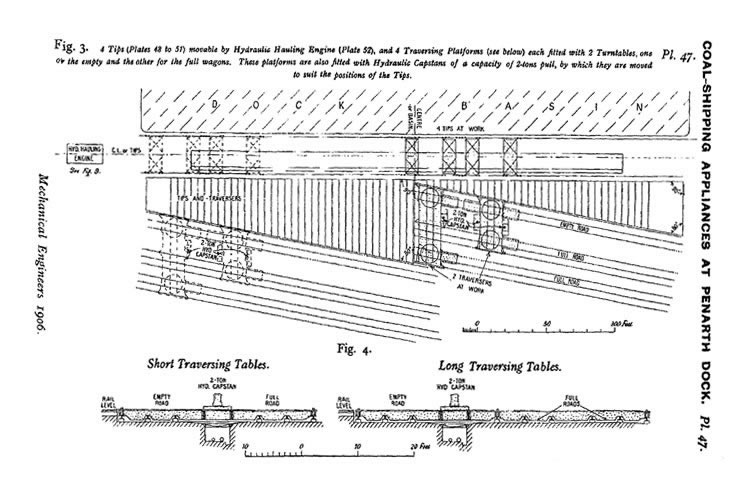
The plant referred consist of four moveable tips which run on rails like traveling cranes, so that they can all be brought to bear on a vessel at the same time. The loaded wagon of coal, the standard capacity of which is ten tons, runs down by gravity when the hand-brake is released, from an adjacent siding on to the cradle of the tip, and it is immediately raised by hydraulic power to a maximum height of forty-five feet above the quay level. It is then tipped, the pin holding the door at the lower end is removed, and the contents descend through a shoot in the direction of the ship's hold. . .